Slow Productivity
Watch
Key takeaways
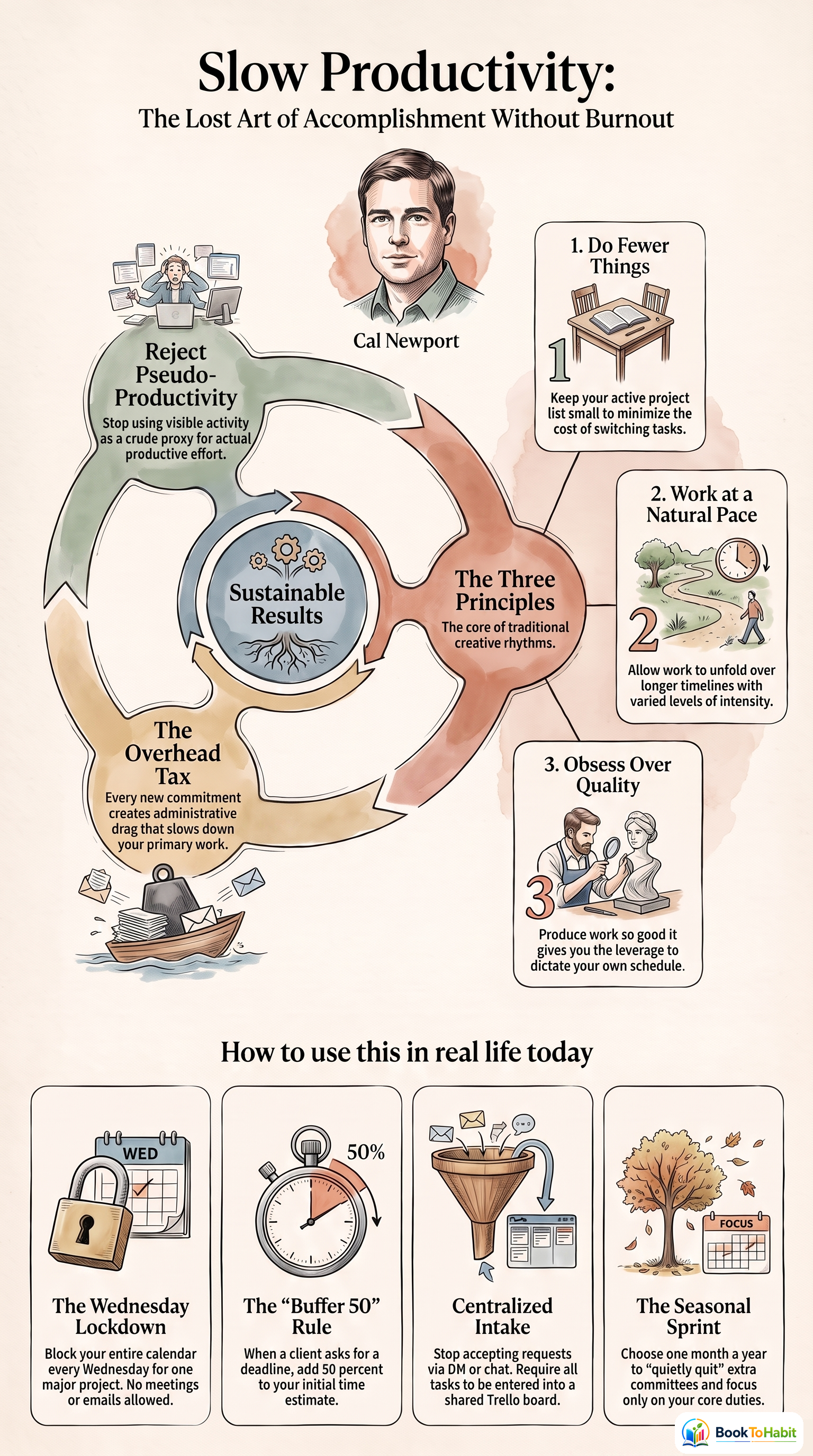
- Do fewer things: Every new task carries an overhead tax of admin work. Fewer commitments free your mind for real, high-value output.
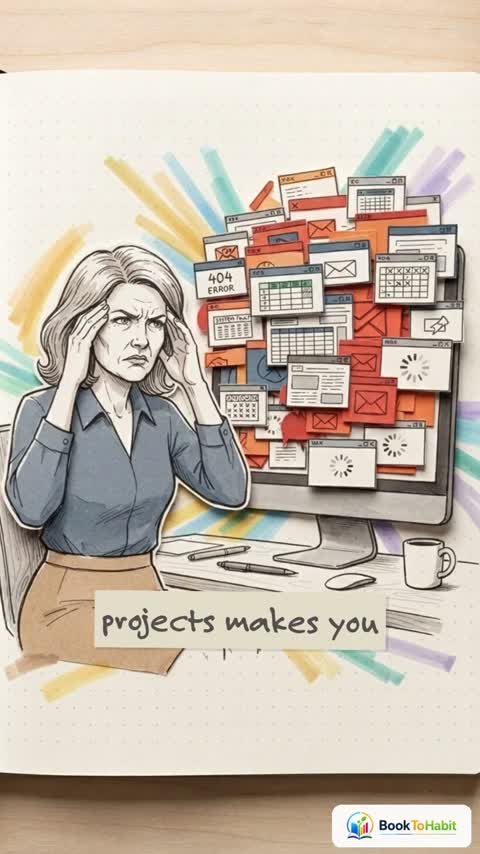
- Kill pseudo-productivity: Emails and meetings look like work but often are not. Stop using visible busyness as a proxy for actual value.
- Work at a natural pace: Your brain wants varied rhythms, not constant grind. Spread projects over time and protect space for deep focus.
- Obsess over quality: One remarkable result outlasts a flood of forgettable content. Choose the campaign that endures over the volume that vanishes.
- Cap your active work: Keep a holding tank for requests. Pull only three projects to your active list at a time to guard your focus.
- Protect deep work: Archive Slack and Teams for focus sprints. Guard blocks of quiet time so hard, original thinking can happen.
What is Slow Productivity about?
Knowledge work has fallen into the trap of pseudo-productivity, a frantic state where visible activity acts as a deceptive proxy for actual results. In his latest work, Slow Productivity, Cal Newport excavates the roots of this exhaustion and presents a sophisticated counter-philosophy for the modern era.
Newport traces the historical shift of our labor from the Neolithic Revolution to the current "Invisible Factory" of knowledge work. While our brains are biologically wired for the varied rhythms of foraging, modern offices demand a continuous, artificial monotony. In the absence of clear metrics, we have defaulted to pseudo-productivity: using the visible activity of emails and meetings as a heuristic for value. To escape this, Newport establishes three core pillars: Do Fewer Things, Work at a Natural Pace, and Obsess over Quality.
This relentless busyness creates a crippling "overhead tax." Every new commitment brings a hidden cost of administrative chores that inevitably leads to the Zoom Apocalypse. By intentionally doing less, we reduce this tax, allowing our cognitive resources to move beyond shallow tasks and toward original, high-value output. Newport’s logic suggests that doing less is not a retreat from ambition but a strategy to respect human biology and produce work that truly endures.
In 2024, these principles can transform modern workflows. A digital marketing agency might shift from "per-post" volume metrics to a "quarterly narrative" focus, prioritizing one high-impact campaign over a flurry of forgettable content. Remote software teams could implement "asynchronous-only" focus sprints, where Slack and Teams are intentionally archived for a week to allow for deep-architecture development. Finally, creative directors might adopt "simulated pull" systems for client intake, ensuring a project is fully polished before the next is ever initiated.
FAQ
What is Slow Productivity about?
Knowledge work has fallen into the trap of pseudo-productivity, a frantic state where visible activity acts as a deceptive proxy for actual results.
What are the key takeaways from Slow Productivity?
Do fewer things: Every new task carries an overhead tax of admin work. Fewer commitments free your mind for real, high-value output. Kill pseudo-productivity: Emails and meetings look like work but often are not. Stop using visible busyness as a proxy for actual value. Work at a natural pace: Your brain wants varied rhythms, not constant grind. Spread projects over time and protect space for deep focus.
Is there a free summary of Slow Productivity?
Yes. This page has a short video summary and a free one-page infographic of Slow Productivity that you can read in about a minute.
Updated 2026-09-19