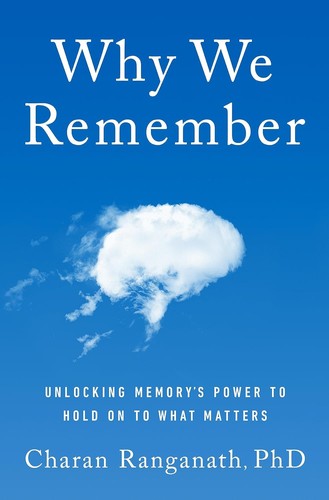
Why We Remember: Unlocking Memory's Power to Hold On to What Matters
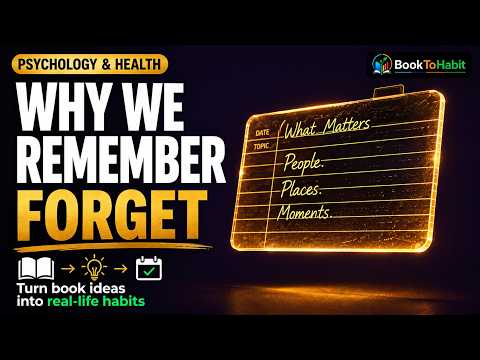
Watch
Key takeaways
- Forgetting is a feature: Your brain drops mundane details on purpose. Clearing clutter lets you focus on the distinctive information that matters.
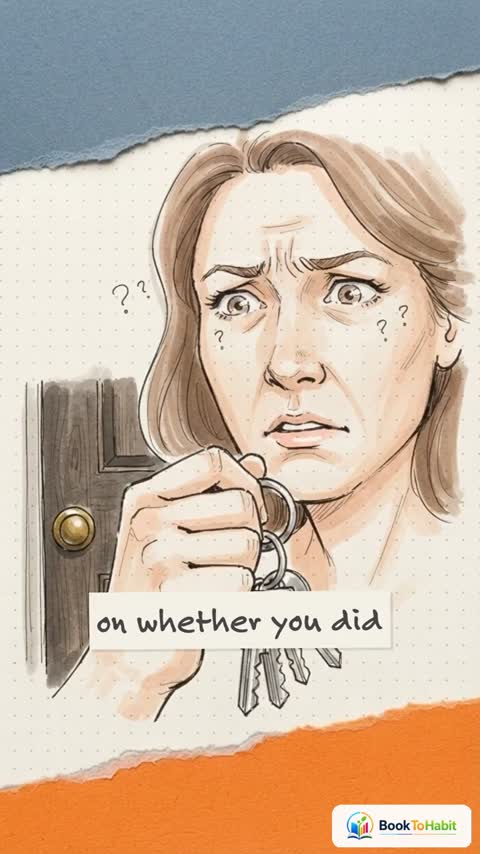
- Use intentional attention: Narrate one unique detail out loud: I am putting my keys by the coffee tin. It locks context into memory.
- Memory guides the future: Your remembering self curates a narrative that drives decisions. It predicts what happens next, not a perfect replay.
- Use event boundaries: Pause at your office door to switch from work-mode to home-mode. Clean mental resets stop stress from spilling over.
- Anchor to what you know: Learning new software Map two or three features to your current tools to cut prediction error and learn faster.
- Make moments distinctive: Similar days blur together. Add one vivid, unique detail to an event so your brain can index and recall it.
What is Why We Remember: Unlocking Memory's Power to Hold On to What Matters about?
In Why We Remember, neuroscientist Charan Ranganath, PhD, reveals that your memory is not a dusty archive-it is a sophisticated blueprint for your future. Your "remembering self" is currently making your most critical life decisions, and mastering its hidden mechanics is the only way to own your daily choices.
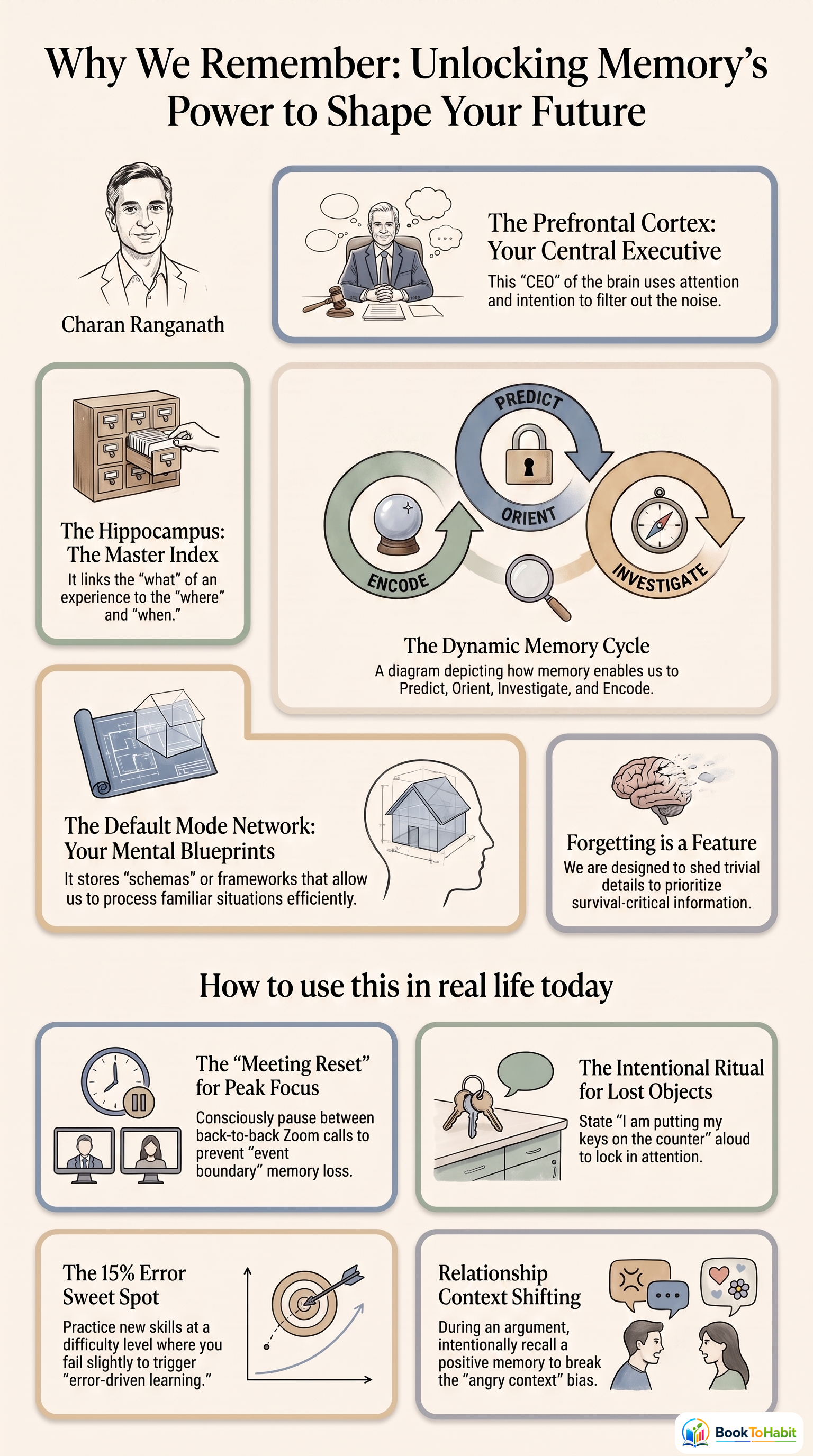
Paragraph 1 (The Core Mechanism): The brain distinguishes between the "experiencing self," which lives through the moment, and the "remembering self," which curates the narrative driving your future actions. We build these narratives through "cell assemblies"-neural alliances that strengthen via plasticity. Crucially, Ranganath explains that we are biologically designed to forget. This isn't a bug; it's a vital productivity feature to avoid "interference" from mundane, competing data. By clearing the clutter, your Central Executive (located in the prefrontal cortex) can focus exclusively on the distinctive information required to hit your high-level goals.
Paragraph 2 (Why it Matters): Memory acts as a prism for the present and a precision blueprinting tool for the future. Your hippocampus serves as an "index" for episodic memory, facilitating "mental time travel" where you re-experience the specific context-the where, when, and how-of an event. When you aren't focused on a specific task, your Default Mode Network (DMN), or internal processing hub, uses these indexed blueprints to generate predictions. This system isn't designed for photographic accuracy. It's an adaptive machine designed to help you navigate a changing world by using past data to calculate what might happen next.
Paragraph 3 (The Habit Application): Deploy Intentional Attention to anchor your virtual meetings by narrating one unique visual detail per call to prevent sessions from blurring together. Use Event Boundaries as a hard reset for your mental state. Pause at your office door to consciously exit work-mode and enter home-mode to stop stress spillover. When learning new software, map it to your existing Schemas. Identify exactly 2 or 3 anchor features that mirror your current tools to minimize prediction error and accelerate your skill acquisition.
---
FAQ
What is Why We Remember: Unlocking Memory's Power to Hold On to What Matters about?
In Why We Remember, neuroscientist Charan Ranganath, PhD, reveals that your memory is not a dusty archive-it is a sophisticated blueprint for your future.
What are the key takeaways from Why We Remember: Unlocking Memory's Power to Hold On to What Matters?
Forgetting is a feature: Your brain drops mundane details on purpose. Clearing clutter lets you focus on the distinctive information that matters. Use intentional attention: Narrate one unique detail out loud: I am putting my keys by the coffee tin. It locks context into memory. Memory guides the future: Your remembering self curates a narrative that drives decisions. It predicts what happens next, not a perfect replay.
Is there a free summary of Why We Remember: Unlocking Memory's Power to Hold On to What Matters?
Yes. This page has a short video summary and a free one-page infographic of Why We Remember: Unlocking Memory's Power to Hold On to What Matters that you can read in about a minute.
Updated 2026-09-19