The Expectation Effect
Watch

Key takeaways
- Meet your inner pharmacy: Expecting healing makes your brain release its own dopamine and opioids. Belief triggers real, measurable chemical change.
- Beware the nocebo: Negative expectations release chemicals that increase real pain and discomfort. Catastrophizing can make symptoms physically worse.
- Reframe stress as fuel: Read a racing heart as excitement, not anxiety. The same arousal, relabeled, sharpens your focus and performance.
- Rename your fatigue: Call tired muscles a growth signal, not exhaustion. Your brain then releases energy reserves it usually holds back.
- Savor your food richer: Label meals with decadent, sensory words. Indulgent expectations trigger a stronger biological fullness response.
- Override your predictions: Your assumptions are biological commands, not facts. Consciously reframe them to reshape how your body responds.
What is The Expectation Effect about?
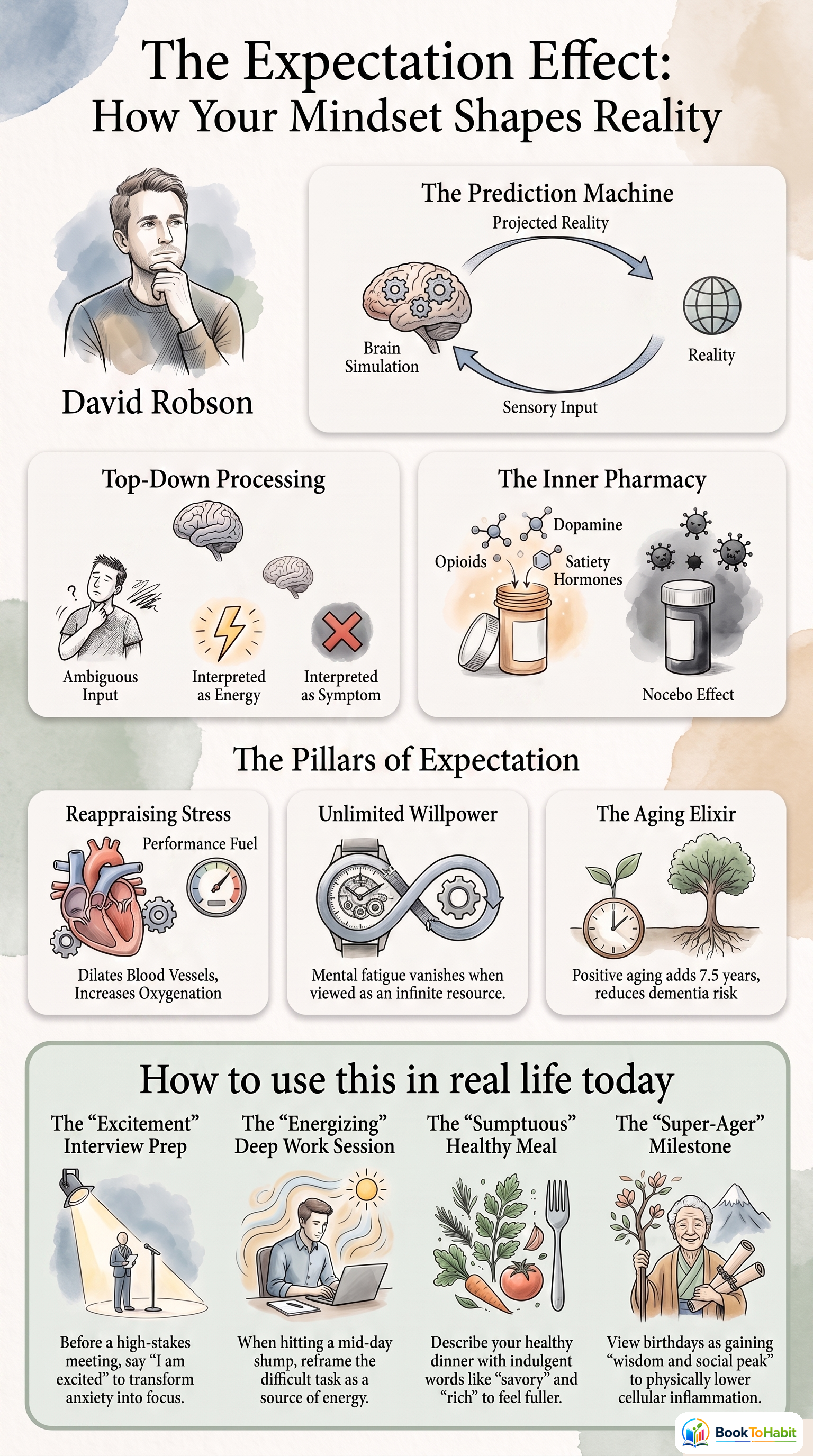
Your assumptions about your health and capability are not objective truths. They are biological commands that the brain uses to simulate and shape your physical reality.
According to the Prediction Machine theory, the brain is not a passive observer of the world but an active simulator. Using "unconscious inference," it constructs a model of what it expects to encounter before sensory data even arrives. This was famously demonstrated in the MIT Brew study, where drinkers actually preferred beer laced with balsamic vinegar until they were told of the "secret ingredient." Their negative expectations overrode the physical taste, proving that our internal simulations frequently discount raw sensory data to create a coherent, subjective version of reality.
These expectations act as a manual for your "Inner Pharmacy," a biological response system that alters your physiology based on anticipated outcomes. When you expect healing, the brain releases its own supply of dopamine and opioids to soothe pain. Conversely, the nocebo effect acts as an evil mirror image where negative expectations trigger chemicals like cholecystokinin (CCK) to increase physical discomfort. This is distinct from the deprivation mindset, which specifically alters your metabolism by triggering the hormone ghrelin. These are not imagined symptoms but measurable shifts in our nervous and immunological systems driven by the brain's desire to prepare for a predicted future.
You can tap into these biological pathways by using reframing as a manual override for your automatic prediction engine. In high-stakes work environments, reappraise a racing heart as "excitement" rather than "anxiety" to improve vocal clarity and focus. For better health, label home-cooked meals with decadent, sensory-rich adjectives to trigger a higher biological satiety response. Finally, during physical activity, reframe sensations of fatigue as a "muscle growth signal" to allow your brain to release the hidden reserves of energy it usually holds back for survival.
FAQ
What is The Expectation Effect about?
Your assumptions about your health and capability are not objective truths.
What are the key takeaways from The Expectation Effect?
Meet your inner pharmacy: Expecting healing makes your brain release its own dopamine and opioids. Belief triggers real, measurable chemical change. Beware the nocebo: Negative expectations release chemicals that increase real pain and discomfort. Catastrophizing can make symptoms physically worse. Reframe stress as fuel: Read a racing heart as excitement, not anxiety. The same arousal, relabeled, sharpens your focus and performance.
Is there a free summary of The Expectation Effect?
Yes. This page has a short video summary and a free one-page infographic of The Expectation Effect that you can read in about a minute.
Updated 2026-09-19