Atomic Habits
Watch

Key takeaways
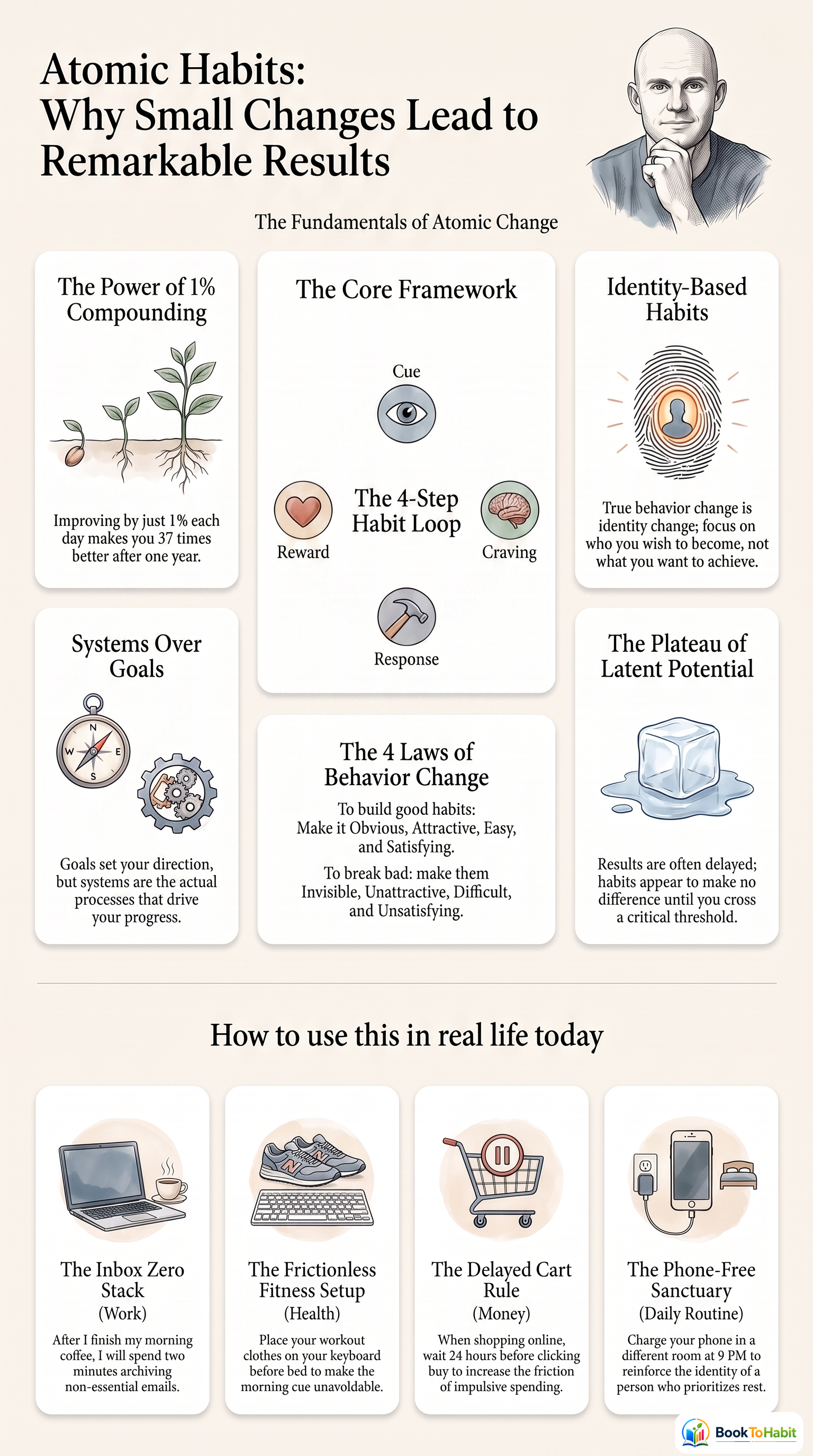
- Focus on systems, not goals: Goals set the direction, but your daily systems decide if you get there. Fall in love with the process.
- Get 1% better every day: Tiny gains compound. Improving just 1% a day makes you about 37x better in a year.
- Change your identity: Don't aim to 'run a marathon.' Become 'a runner.' Habits stick when they match who you believe you are.
- Make it obvious and easy: Design your environment. Put the cue in sight and remove friction, so the good habit is the easiest option.
- Stack your habits: Anchor a new habit to one you already do: 'After I pour my coffee, I write one sentence.'
- Never miss twice: Missing once is an accident. Missing twice starts a new bad habit. Get back on track immediately.
What is Atomic Habits about?
Stop fighting against your own biology. This breakdown of James Clear’s Atomic Habits reveals the exact engineering required to automate success and finally bridge the gap between who you are and who you want to become.
James Clear redefines atomic not just as something small, but as a source of immense power within a larger system. To achieve remarkable results, the author argues we must abandon the goals-first mentality that restricts our happiness and instead focus on the aggregation of marginal gains. By prioritizing systems over results, we solve problems at the input level, where the actual change happens. The most transformative shift involves building identity-based habits, where every action serves as a vote for the person you wish to become. This move from what you want to achieve to who you want to be ensures your behavior remains congruent with your self-image.
The mechanics of change are rooted in the neurological habit loop, a four-stage feedback cycle: cue, craving, response, and reward. When these stages are optimized through the Four Laws of Behavior Change, routines move from the conscious mind to the automatic nonconscious mind, effectively reducing cognitive load and freeing up mental capacity. This triggers the power of compounding, where small improvements multiply over time like interest in a bank account. Most people quit during the Valley of Disappointment, but progress is stored until you cross the Plateau of Latent Potential, much like an ice cube finally melting only when the temperature reaches exactly 32 degrees.
To apply these frameworks today, you can optimize remote work by creating a digital environment design where your Slack notifications are muted automatically during deep-work blocks. In personal finance, use a DeFi protocol to automate micro-investments that round up your digital purchases into a compounding index. For modern fitness, try stacking your physical activity with wearable tech by allowing your Oura ring or Whoop data to serve as the satisfying reward that validates your identity as a high-performing athlete. Finally, manage digital wellness by using browser extensions that hide YouTube suggested sidebars, making the cue for doom-scrolling invisible.
FAQ
What is Atomic Habits about?
Stop fighting against your own biology.
What are the key takeaways from Atomic Habits?
Focus on systems, not goals: Goals set the direction, but your daily systems decide if you get there. Fall in love with the process. Get 1% better every day: Tiny gains compound. Improving just 1% a day makes you about 37x better in a year. Change your identity: Don't aim to 'run a marathon.' Become 'a runner.' Habits stick when they match who you believe you are.
Is there a free summary of Atomic Habits?
Yes. This page has a short video summary and a free one-page infographic of Atomic Habits that you can read in about a minute.
Updated 2026-09-19