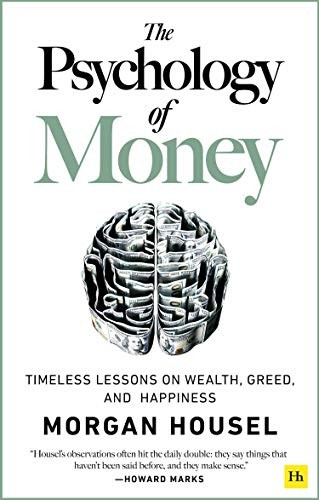
The Psychology of Money
Key takeaways
- Behavior beats brains: A janitor left 8 million dollars a Harvard exec went bankrupt. Money is a soft skill, not a math test.
- Let compounding run: Most of Buffett's fortune came after age 65. Wealth grows when you leave your gains alone for decades.
- Respect luck and risk: Both are siblings you cannot control. Stay humble in wins and forgiving in losses, because outcomes are never fully earned.
- Wealth is unseen: True wealth is the money you do not spend. The car you skip buys you future freedom and control.
- Define your enough: Without a finish line, the goalposts move forever. Know what enough means before greed pushes you toward ruin.
- Save for freedom: Automate savings with no specific goal. The real payoff is control over your time and how you spend your day.
What is The Psychology of Money about?
Most people believe financial success is a math problem, but why did a humble janitor named Ronald Read leave behind 8 million dollars while a Harvard-educated Merrill Lynch executive like Richard Fuscone went bankrupt? The truth is that doing well with money has little to do with your IQ and everything to do with your behavior. It is time to stop treating finance like physics and start understanding the greatest psychological show on Earth.
Financial success is not a hard science, it is a soft skill where your behavior is more important than your technical knowledge. While the world chases high-risk returns, the real engine of wealth is what Morgan Housel calls "Confounding Compounding." Just as the Russian meteorologist Wladimir Köppen discovered that ice ages are caused by "cool summers" where the previous winter's snow simply lasts, wealth is built when you allow your gains to survive. Warren Buffett is the ultimate example: of his 84.5 billion dollar net worth, a staggering 81.5 billion arrived after his 65th birthday. The secret is not just being a good investor, but being a good investor for three-quarters of a century. True wealth is the income you choose not to spend, providing you with the ultimate dividend: the ability to control your time.
Humans struggle with money because we are all "newbies" to the modern financial system. We are winging it with tools like the 401(k), which only dates back to 1978, and the Roth IRA, which was born as recently as 1998. We are frequently blind to the roles of luck and risk, which Housel describes as siblings. Bill Gates had a one-in-a-million stroke of luck by attending Lakeside School, the only high school in the world with a computer in 1968, while his equally brilliant friend Kent Evans suffered the one-in-a-million risk of a fatal mountaineering accident before graduation. This complexity leads us to the "Man in the Car Paradox," where we spend money on status symbols to gain admiration, failing to realize that onlookers only admire the car and never the driver. Without defining "Enough," the goalposts will always move, eventually pushing even the smartest people toward ruin.
Establish a "Flexibility Fund" specifically designed to facilitate a career pivot. This allows you to transition when a high-pressure, "thought-labor" job begins to cause burnout, buying you the time to find a role that aligns with your lifestyle rather than your debt. Automate your savings to bridge the gap between your ego and your income. By treating humility as a financial asset, you ensure your wealth grows without the need for constant, high-willpower decisions. When you receive a major promotion, intentionally choose to keep your 5-year-old vehicle. This decision explicitly prioritizes future time-freedom over a temporary signal of status, keeping your wealth hidden where it can compound. Create a portfolio that includes a small "sanity" percentage of individual stocks you personally love. Following the lead of professional investors like Josh Brown, this "reasonable" approach acknowledges that having an emotional connection to a few stocks makes you more likely to stay committed to your boring, "rational" index funds during a market crash.
FAQ
What is The Psychology of Money about?
Most people believe financial success is a math problem, but why did a humble janitor named Ronald Read leave behind 8 million dollars while a Harvard-educated Merrill Lynch executive like Richard Fuscone went bankrupt?
What are the key takeaways from The Psychology of Money?
Behavior beats brains: A janitor left 8 million dollars a Harvard exec went bankrupt. Money is a soft skill, not a math test. Let compounding run: Most of Buffett's fortune came after age 65. Wealth grows when you leave your gains alone for decades. Respect luck and risk: Both are siblings you cannot control. Stay humble in wins and forgiving in losses, because outcomes are never fully earned.
Is there a free summary of The Psychology of Money?
Yes. This page has a short video summary and a free one-page infographic of The Psychology of Money that you can read in about a minute.
Updated 2026-09-19