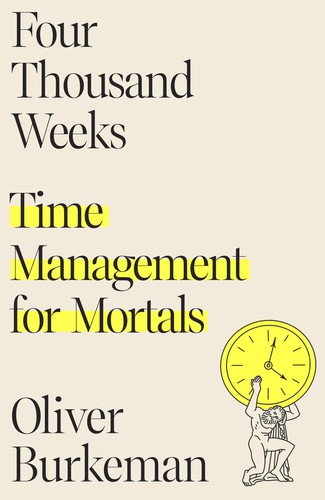
Four Thousand Weeks: Time Management for Mortals
Key takeaways
- Accept your limits: You will never get on top of everything. Embracing your finitude is the first step to actually feeling at peace.
- Escape the efficiency trap: Getting faster just invites more demands. The conveyor belt speeds up, so doing more only makes you feel busier.
- Choose one path: Every yes means missing a thousand other lives. Commit to a few finite choices and let the rest go.
- Value the present: Stop treating today as a bridge to a perfect future. The moment you are in is the only life you get.
- Do atelic activities: Enjoy things with no end goal, like a walk or washing dishes. Meaning lives in the doing, not the finishing.
- Practice radical incrementalism: Set a timer and stop when it rings, even mid-flow. Building patience matters more than one heroic burst of work.
What is Four Thousand Weeks: Time Management for Mortals about?
If you reach the age of eighty, you have approximately four thousand weeks to live. Oliver Burkeman's "Four Thousand Weeks" argues that our modern obsession with productivity is actually a desperate flight from the terrifying reality of our own mortality.
The central premise of this work is that human finitude is the defining constraint of our existence. Most time management systems fail because they ignore this reality, promising a future state of total control that never arrives. This leads to the "Efficiency Trap," a phenomenon where becoming more productive simply causes the metaphorical conveyor belt of tasks to speed up. As the source explains, when you become faster at processing requests, you inadvertently invite more demands, ensuring that you feel busier and more anxious rather than finding the peace of mind you were promised.
This constant striving results in "Existential Overwhelm," where the sheer volume of possibilities provided by the modern world far exceeds our capacity to experience them. This is exacerbated by the loss of a cyclical or afterlife worldview, as detailed by Hartmut Rosa, leaving us adrift in a linear rush toward the end. We fall victim to the "Causal Catastrophe," judging our current actions solely by the future results they produce rather than their intrinsic quality. By treating the present as a mere bridge to a future that we imagine will be perfect, we drain our finite weeks of their actual meaning.
Applying these ideas requires reclaiming the present from the pressure of optimization. One might choose to navigate a new city using a physical paper map instead of GPS, deliberately re-introducing the friction of travel to experience the reality of a place. Another might opt to hand-wash the dinner dishes as an atelic activity, focusing on the sensory experience of the water and soap rather than rushing to save time with a machine. Finally, one could commit to a single, deep volunteer project for a year, intentionally letting other worthy causes go ignored to find the profound fulfillment that only comes from choosing one finite path.
FAQ
What is Four Thousand Weeks: Time Management for Mortals about?
If you reach the age of eighty, you have approximately four thousand weeks to live.
What are the key takeaways from Four Thousand Weeks: Time Management for Mortals?
Accept your limits: You will never get on top of everything. Embracing your finitude is the first step to actually feeling at peace. Escape the efficiency trap: Getting faster just invites more demands. The conveyor belt speeds up, so doing more only makes you feel busier. Choose one path: Every yes means missing a thousand other lives. Commit to a few finite choices and let the rest go.
Is there a free summary of Four Thousand Weeks: Time Management for Mortals?
Yes. This page has a short video summary and a free one-page infographic of Four Thousand Weeks: Time Management for Mortals that you can read in about a minute.
Updated 2026-09-19